The Father of Modern Medicine, Ibn-i Sina.
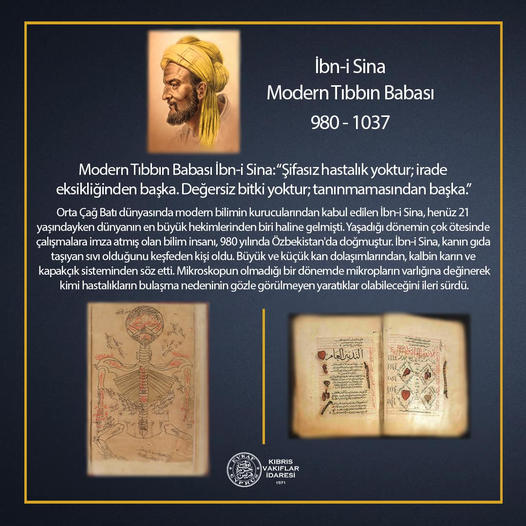
The Father of Modern Medicine, Ibn-i Sina.
Father of Modern Medicine, Avicenna: There is no incurable disease; other than a lack of willpower. There are no worthless plants; other than not being recognized.
Considered one of the founders of modern science in the medieval Western world, Ibn Sina had become one of the world's greatest physicians at the age of 21.
The scientist, who carried out studies far beyond the period in which he lived, was born in Uzbekistan in 980. His work and ideas are unquestionably accepted all over the world even today.
During the Middle Ages, when the study of the human body was considered a sin by the church in the West, Muslims who obeyed the command of the Qur'an to 'investigate, research' learned the anatomy and physiology of the human body at very high levels. Ibn Sina is the pioneer of these names.
Ibn Sina was the one who discovered that blood is the liquid that carries food. He spoke of the great and small circulations, the ventral and valvular system of the heart. Mentioning the existence of microbes at a time when there was no microscope, he suggested that the cause of transmission of some diseases could be invisible creatures.
He became known in the western world as "Avicenna". El-Kanun fi't-Tıb, i.e. Medicine Law, has 10 translations from Arabic to Latin. This encyclopedic book was taught as a fundamental work in Western universities for 400 years. Described as the "Pioneer of Physicians", with the phrase "Grand Master"."
Known as the Cannon of Medicine, the book can be viewed at The British Museum in London.
Avicenna, who is a philosopher, physicist, astronomer and writer besides his medicine, draws attention to the importance of science with the statements "There is no incurable disease; other than the lack of will. There is no worthless plant; other than being not known".